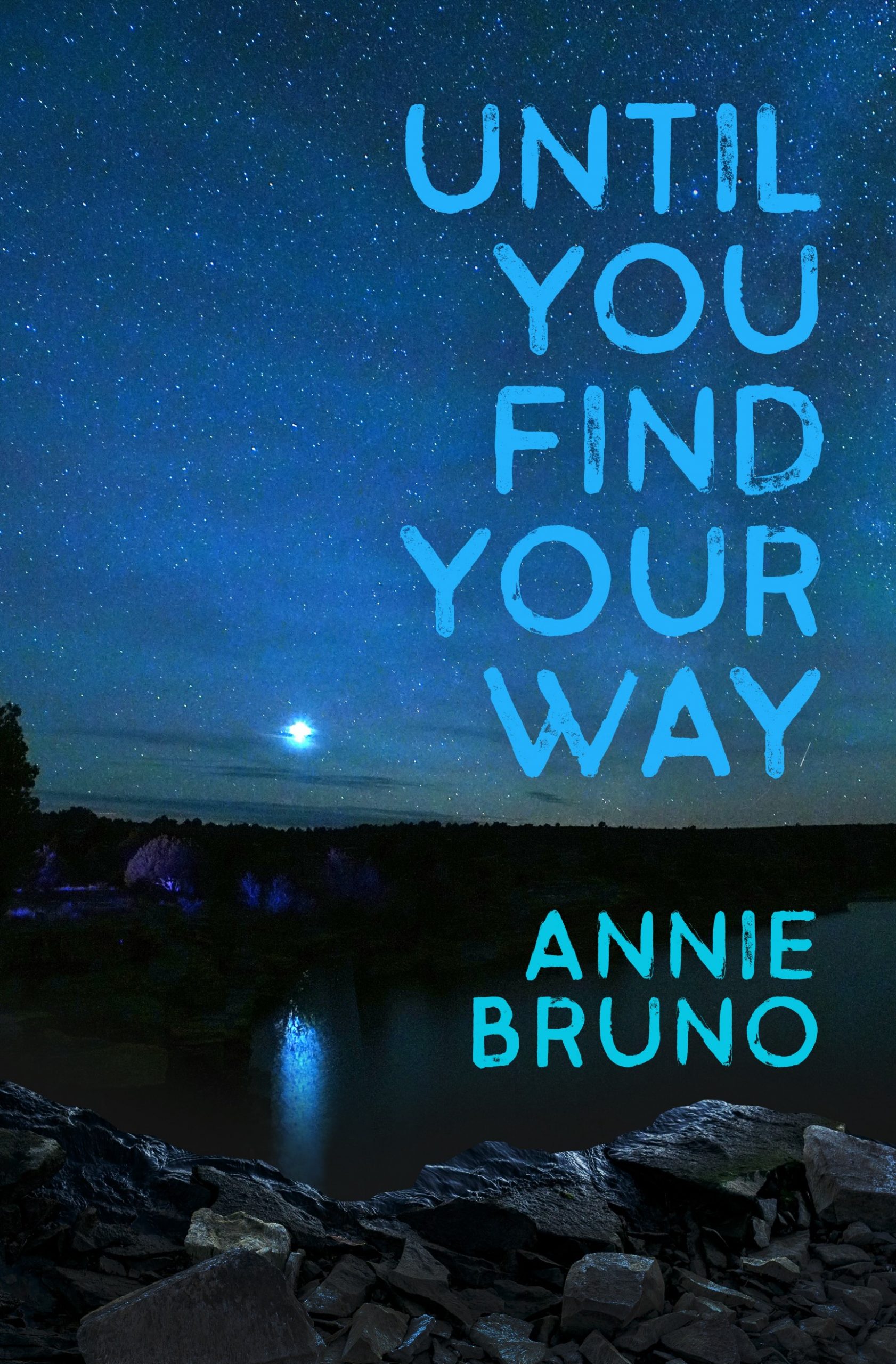
 If anyone had told Annie Bruno that the novel she thought was on the verge of publication wouldn’t come out for another 30 years, she would never have believed it. How did she sustain her belief? She didn’t. But she found her way back to the novel, and it found its way into the world.
Preorder Until You Find Your Way from Itasca Books, Amazon, Barnes and Noble, or Bookshop
What inspired you to write Until You Find Your Way?
The novel began with Beada, inspired by the memory of a childhood friend’s mother who raised horses in rural Minnesota. She was strong, self-assured, and a little loose with rules—qualities that made her magnetic to me as a young girl. After high school I left that rural landscape, but the memory of her never left me. She embodied a physical confidence and groundedness that felt elemental, almost mythic, and I think I carried that image of her into adulthood as a kind of touchstone.
As Beada developed on the page, she became more than that early inspiration. She evolved into a composite of women I’ve known—my mother included—and parts of myself. My mother also carried beauty and strength, though hers was quieter, less overtly rebellious. The tension between those two expressions of womanhood fascinated me. Beada’s story grew into an exploration of the quiet struggle between expectation and inner truth, particularly within family life.
In the novel, Beada is living through that middle terrain in raising a family—those adolescent years—when communication becomes more fraught and expectations go underground. Parents and children begin wrestling privately with identities that no longer align as easily as they once did. The early death of Beada and Porter’s first child intensifies her isolation. Grief becomes an unspoken presence at the table. Everyone longs for connection, yet each retreats inward. That dynamic—yearning and distance existing simultaneously—became the emotional center of the book.
What does “strong” mean to you?
Strength, to me, is the balance between taking responsibility for your life and being willing to ask for what you need. The first requires self-knowledge. You have to understand who you are—what feels true—before you can move toward it. Without that clarity, it’s easy to live according to expectations and then quietly blame others for the dissatisfaction that follows.
That blame can break bonds. In the novel, both generations are coming of age. Beada and Porter are navigating separation—physical and emotional—while their children are trying to define themselves as adults. Father Sean, the third point in the unconventional love triangle, is also caught between duty and authenticity. Each character, in their own way, is trapped in the gap between the life prescribed to them and the life that feels honest.
In fact, the epigraph of the novel is a line from a poem by Eamon Grennan about being trapped. The novel is structured based on that line about a bat caught indoors, out of his element and seeking freedom. All of the novel’s characters are caught like that bat, blind to each other in certain ways as they find their way to that open window where the struggle ends.
Why portray women’s interior lives with such depth?
Our interior lives are the source of common ground that make novels so powerful. As a young reader, novels that revealed women’s private thoughts helped me recognize and trust my own. Their stories made me feel less alone in experiences I was having that no one talked about.
That interest in interiority deepened during my graduate study. I wrote about A Question of Power by Bessie Head, a semi-autobiographical novel exploring identity, exile, and mental illness under apartheid in South Africa. I also studied Nectar in a Sieve by Kamala Markandaya, which portrays a woman married at twelve and struggling to maintain her resilience during social upheaval in India. Though my life was vastly different—and far easier—these books shaped how I understood interiority as a site of resistance and dignity.
I have also always been interested in the relationship between women’s inner lives and their bodies. Girls often become objects of perception before they have fully formed their own self-understanding. Fiction helps women to distinguish what is true about themselves from what others want them to be. Being able to distinguish that from a young age makes an enormous difference in the paths women take and ultimately how fulfilling their lives become.
What drew you to explore grief and a love triangle?
Grief asks for a particular kind of intimacy. It is inexpressible, yet it demands expression. When someone experiences profound loss, language often fails. It can feel impossible to be met by another person—emotionally, physically, spiritually—at the depth of that pain.
The love triangle in the novel emerged organically from a confession scene. Beada, who is not religious and feels like an outsider in her small town, nevertheless continued to go to confession after leaving the church because it gave her a space to talk candidly about her own life. After her son’s death, her talks with Father Sean became increasingly essential. They gave her comfort and solace her husband was at a loss to provide. Because of that, she both longed for her connection with Father Sean and resisted it.
Porter, meanwhile, is not completely absent. He is struggling in his own way to return to the family—to repair what he cannot articulate. He senses Beada’s distance and perceives the presence of a third party but misidentifies both her motivation and the person. As Beada, Porter, and Father Sean collide and retreat, as they deal with the aftershocks of their actions, each must confront what they truly want and what they are willing to sacrifice to get it.
How does the 1993 small-town setting shape the story?
If not set in 1993, the novel could not have unfolded as does. Without the internet, mobile phones, or social media, distance carried real weight. Porter, living abroad in Bangkok, cannot easily bridge the gap with his children in Minnesota. Communication requires effort and is often untimely. Silence lingers longer, and so do secrets. Geographic cures are more effective because emotional separation is inherent in long distances.
For the children, their father’s life in Bangkok feels mysterious, almost mythic, on one hand, but on the other, so far away as to have no real meaning or impact on their own lives, a feeling that extends to their father himself.
The other significant part of the 1990s setting is that the kids grow up and make decisions in relatively privacy, something that doesn’t seem to exist for teens anymore. Emilee’s choices about school and Barry’s unusually mature relationship with an older girl develop without the constant visibility and scrutiny that now seems inherent to adolescent lives.
What role does storytelling play today, especially for women’s voices?
To me, storytelling remains what it has always been: sharing an experience that can provide an escape or a homecoming for others. It transports us into another consciousness while deepening our own.
What’s different now is that women’s voices feel clearer and more unapologetic in my lifetime. When I listened to Catherine Connolly speak after taking office in Ireland in 2025, I was struck by how grounded her speech felt in priorities often voiced by women—care, equity, interconnectedness. It signaled to me how much space has opened for women to articulate power differently.
Literature and film that center women’s experiences—and pass measures like the Bechdel-Wallace Test—expand that space further. When readers encounter complex female protagonists, they internalize broader definitions of leadership, strength, and vulnerability. Storytelling doesn’t replace policy or activism, but it shapes the emotional landscape in which those forces operate. It builds empathy, and empathy precedes change.
Can you describe your creative process?
My process always begins with an image, whether it’s an image from a memory or something that I see or witness in the moment. When that image is strong enough, a story begins to take shape in my mind. All it takes is one scene that leads to another then another. The potency of that one image, for me, can launch a whole world. I’m not one for outlines, but once I have a first draft, I do map the primary and secondary story arcs. Every character needs to go on a journey of some kind. The need to change and evolve for us to care about them.
Editing is something I enjoy, so a big part of my process is doing an entire pass on the novel focused on one thing: the transitions between chapters, deepening the sense of place or a certain relationship. I have rewritten more than one novel changing from a first person to third person omniscient narration. That creates a number of interesting tradeoffs: distinct voices for the ability to shift between points of view in a single scene is one example.
Having readers and feedback is a huge part of my process too. Finding a close reader who wants to help you is an enormous gift. I had several who helped Until You Find Your Way become what it is today.
What challenges did you face?
The hardest challenge was sustaining belief. Writing a novel requires enormous patience—not only with the work but with yourself. Your understanding of truth evolves as you age. Sometimes a new insight demands a structural change that ripples through hundreds of pages. You can spend months reworking a single motivation.
There were moments when trusted readers questioned revisions I knew were necessary. Holding onto my own sense of the book’s direction, even when external validation wavered, was the most difficult task. Yet those revisions ultimately made the novel deeper and more aligned with what felt meaningful to me. What I guess I’m saying is that sometimes you, as the writer, know best, and backing yourself can be harder than you think it will be.
What was your journey to publication like?
Long and nonlinear. I began the novel in my early twenties. The first draft was 575 pages, mailed in a cardboard box to an agent. It was once close to publication—an editor even took me to lunch in a restaurant where John F. Kennedy Jr. was at an adjacent table—but it ultimately did not sell.
I was devastated. I concluded, incorrectly, that I had written the wrong kind of book. For years I tried other forms—short stories, essays, a screenplay, a young adult novel. Those explorations were valuable, but they also delayed my return to this manuscript.
Then, in 2021, I was visiting a childhood friend who was dying of cancer. She asked about my first novel, and I told her it was sitting on a shelf. She said, so simply, “You have to publish it.” I knew in that moment I would, somehow. When I read it again, after so many years, I realized the book still mattered to me.
When I was ready to try again to find a publisher for Until You Find Your Way, I chose not to use an agent. Instead, I researched contests and submitted to the Howling Bird Press Fiction Prize. Only later did I realize the press was affiliated with Augsburg University, my undergraduate alma mater. When the novel won, it felt unexpectedly full circle. The book had found its home in the same state where it was born imaginatively and where I first began to write seriously.
What do you hope readers take away?
I hope readers find strength for whatever they are facing. If the characters’ choices reveal an opening—a possibility for courage, reconciliation, or self-recognition—that would mean that my novel did what so many novels have done for me. I’m so grateful to so many writers, and this is my attempt to return that intimate experience.
And I do think reading fiction, in particular, is inherently intimate. You sit alone, yet you are accompanied deeply. My hope is that this book offers that companionship. If it makes lasting friends, then it has done more than I could have ever asked of it.